


Three War Outcomes
Through a Real Estate Lens
March 16, 2026





For five years, Dubai's real estate market has defied every forecast thrown at it. Corrections predicted, bubbles warned, slowdowns projected — none materialised.
Instead, 2025 delivered the strongest year on record: 215,000 residential transactions for a total value of 686.8 billion AED, up 30.9% year-on-year (DXB Interact, Dubai Real Estate Yearly Report 2025). Behind the numbers was a city that had become two things at once. The world's foremost address for global wealth — 6,700 migrating millionaires chose Dubai as their new home in 2024 alone, bringing the total to 81,200 (Gulf News). And quietly, something more enduring: one of the most sought-after cities for families relocating for safety, quality of life, and a genuinely child-friendly urban environment. The jet-set narrative was real. So was the other one.
Then March 2026 happened.
Debris from intercepted Iranian missiles and drones fell on the Fairmont The Palm, the Burj Al Arab, Dubai International Airport, Marina 23 and more. Dubai did not choose this war. But the city that had spent decades building the most compelling case for itself as the world's safest, most open, most cosmopolitan address has found its image caught in a conflict that has nothing to do with its own ambitions.
The question is no longer whether the war will affect Dubai's property market. It already has.
The real question is how this ends, who wins, and what it does to your portfolio.
Yet beneath the record headlines, a structural tension was already taking shape. The city was entering 2026 with an unprecedented supply pipeline: nearly 366,000 residential units projected for delivery by 2028, with a heavy concentration scheduled for the following two years. A volume that risked outpacing absorption, making a price correction of up to 10-15% increasingly inevitable in oversupplied pockets of the market.
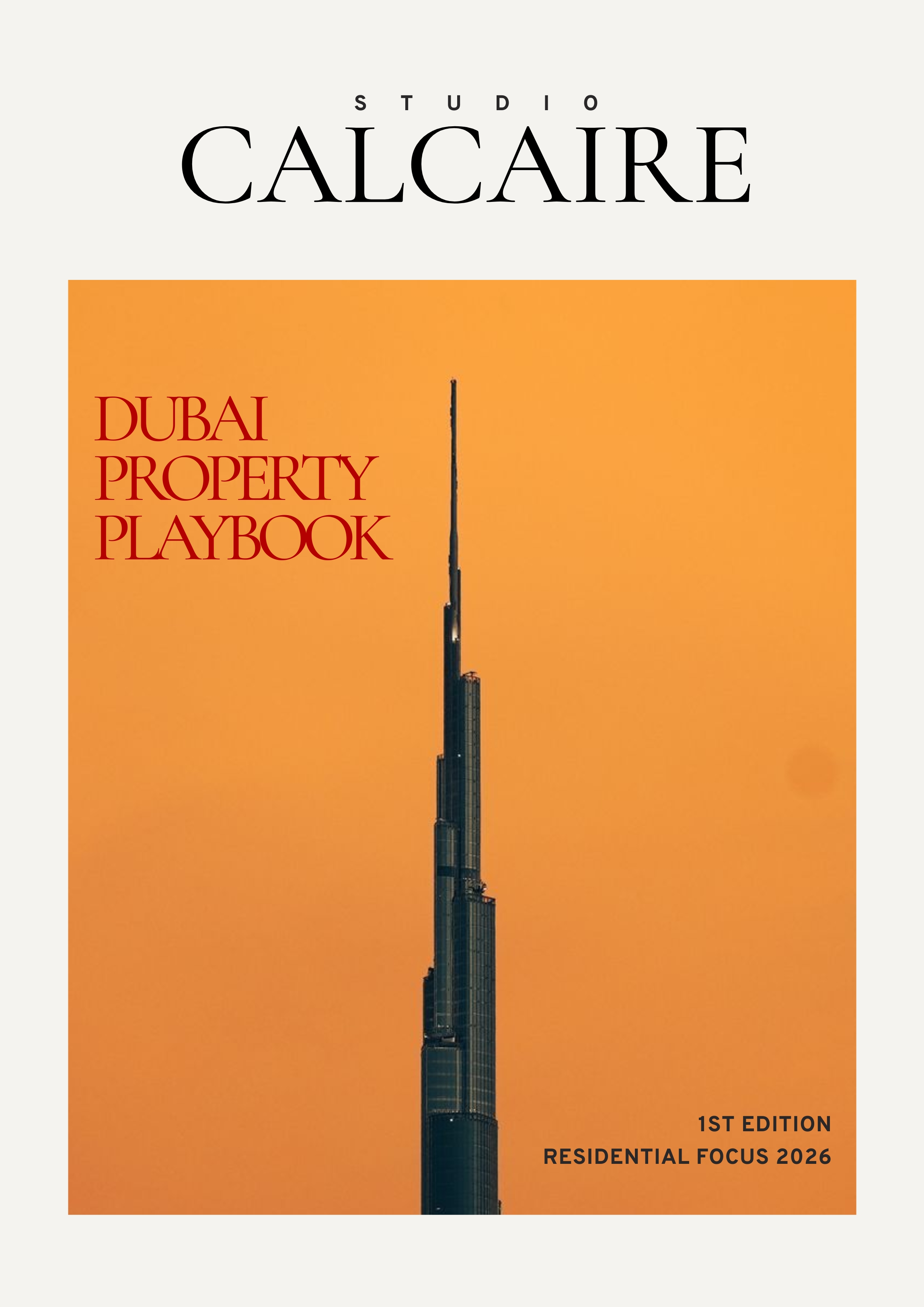
Two factors, however, temper that outlook. First, delivery delays — a structural reality of Dubai's development cycle — tend to spread incoming supply over longer timeframes than announced, softening the impact. Second, ultra-premium districts remain considerably more insulated, driven by primary residence demand rather than speculation. This two-speed market dynamic is analysed in detail in the Studio Calcaire Dubai Property Playbook (link).
The war did not arrive on a fragile market.
It arrived on a market already under supply tension.
But let's get back to what really matters: anticipating the consequences of each war scenario — and what they mean for your assets.
For that, we turn to the work of Professor Jiang, a Yale-educated historian and geopolitical analyst. Jiang recorded a lecture in May 2024 — back when Biden was still in office — in which he predicted three things: Trump's return to power, a U.S. war with Iran, and an eventual American defeat. Jiang lectures on geopolitics through the lens of game theory. "I see geopolitics as a game played by different actors trying to maximise their own self-interest. I don't look at ideology. I focus on interest." Two of his three predictions have since materialised with striking precision. His analysis now points to three structurally distinct endings to the current conflict.
Scenario A — Short war, Western victory. Swift regime change in Iran. Regional recomposition. The Gulf absorbs the shock and resumes its trajectory.
Scenario B — Prolonged war of attrition. Iran — having prepared for this confrontation for over two decades — responds asymmetrically, targeting Gulf infrastructure and exhausting American munitions and political will. Uncertainty becomes the new normal.
Scenario C — American strategic defeat, multipolar reorder. U.S. hegemony fractures. The petrodollar weakens. Global capital reorganises around a new architecture — one in which China and Russia gain strategic ground.
Three radically different futures for one of the world's most watched real estate markets. The one that unfolds will define Dubai's next decade.
Scenario A — Short War, Western Victory — The Safe Haven Effect
The UAE’s defence systems hold. Missiles and drones are intercepted before entering Emirati airspace. The conflict continues elsewhere in the region — but Dubai is effectively removed from the front line. In doing so, it proves something more valuable than peace: capability. Every successful interception becomes a data point. Every week that Dubai’s skyline remains intact strengthens a narrative no marketing campaign could manufacture.Historically, the pattern is familiar. The Arab Spring redirected capital from Egypt, Syria and Libya into Dubai. The Russia-Ukraine war triggered a wave of wealth relocation that helped drive record transaction volumes. Regional instability, when contained beyond the UAE’s borders, has consistently reinforced Dubai’s role as the default destination for displaced capital.Under this scenario, the correction already underway — structural, anticipated, and largely driven by oversupply — accelerates into a sharper but shorter adjustment. Ultra-luxury assets, supported by primary residence demand, would likely remain resilient. For patient buyers, this type of market dislocation historically creates rare entry points.
Short-term volatility. Medium-term opportunity. The correction compresses — but so does the recovery
Scenario B — Prolonged Conflict — The Structural Stress Test
Beyond three months, the calculus changes. Wars of attrition do not arrive all at once. They accumulate gradually, spreading through multiple layers of the economy.
Tourism absorbs the first shock. Dubai welcomed 9.88 million international visitors in the first half of 2025, with hotel occupancy averaging 80.6% (Dubai Department of Economy and Tourism). The 2026 spring season is already compromised. But the deeper risk is not a single lost season — it is the timeline of recovery. Tourists will likely return first, drawn back by Dubai’s comfort, infrastructure, and connectivity. A normalisation of leisure travel by late 2027 is plausible.
Relocating expatriate talent is a different equation. Moving a family requires confidence in long-term stability. Tax-free income alone may no longer be sufficient. Attracting that talent back could take longer — and require stronger financial incentives.
For real estate, the consequences become structural. Developers face compounding pressure: construction delays, supply chain disruptions, and tighter financing conditions. Some projects pause. Others do not restart. Meanwhile, the delivery pipeline scheduled for 2026–2027 — already a concern before the conflict — meets a demand base that is no longer expanding.
Investor confidence retreats. Prices in mid-market and oversupplied districts could correct sharply — potentially 15–30% or more depending on location and asset quality. The ownership market then begins to split into two distinct behaviours. Some owners — leveraged buyers or landlords dependent on rental income — face financial pressure and are forced to sell, generating distressed transactions. Others have a rarer luxury: time. The ability to hold through volatility becomes the most valuable asset in the market.
The market fragments. Location quality and asset design become the final line of defence against
correction.
Scenario C — American Strategic Defeat — The New Order
This is Jiang's most radical scenario — and the least probable in the near term. It is also the one with the longest shadow.
If U.S. hegemony fractures and the petrodollar weakens, the architecture of global capital flows reorganises at a foundational level. The Gulf states lose their role as the financial linchpin of the American economic order. The consequences extend far beyond the region. For Dubai specifically, the scenario is brutal in the short term: expatriates leave, the service economy contracts, the social fabric of a city built on international mobility comes under acute pressure. The rise of Abu Dhabi as a complementary regional pole — more sovereign, more insulated from international volatility — could in fact strengthen the UAE's overall resilience, distributing the country's centre of gravity across two distinct and mutually reinforcing cities.
And yet. The UAE has the resources and the vision to navigate structural shocks that would break other states. In a multipolar world, neutrality becomes the scarcest asset of all. A city that belongs to neither bloc — governed by pragmatism, connected to everyone — does not disappear. It adapts. Those who remain through the disruption, who invest through the noise and the uncertainty, are not simply buying property. They are staking a claim on the next version of this city. In every reordering of the world, there is a place that captures what comes after. Dubai has done it before.
The highest risk. The longest game. And for those with the conviction to play it — potentially the highest asymmetric upside.

Dubai’s real estate market ultimately runs on three forces: security perception, global capital flows, and international population movements. When all three move in the same direction, the market accelerates. When they reverse, the correction follows just as quickly.
Whatever scenario unfolds, four indicators will signal where this market is heading before the headlines do:
• Weekly transaction volumes (DLD / DXB Interact) — the fastest read on investor sentiment
• Hotel occupancy rates — the leading indicator of expatriate confidence
• Oil prices and the Strait of Hormuz — the regional barometer that overrides all others
• Golden Visa flows — the long-term signal that doesn't move on noise
Before March 2026, Dubai was not a risky bet — not for those who knew how to read the market. It was prosperous, legible, and full of momentum. In times of uncertainty, predictions become harder. The direction of this conflict, and how Dubai chooses to respond to it, will only be revealed by time. What is certain is that a page of history is being written. And with it, the lives of millions of people who had chosen to call this city home.